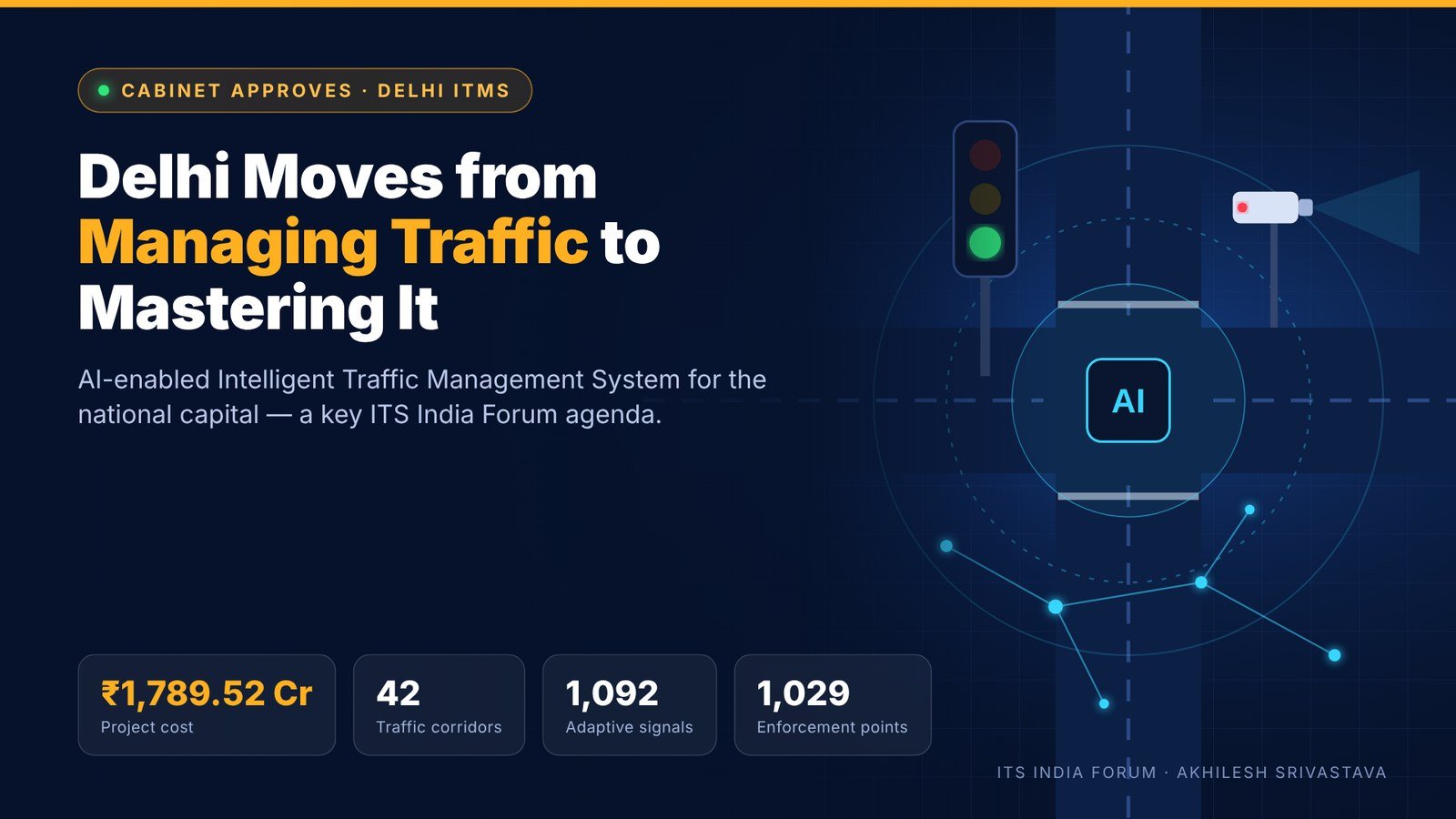
AI-enabled adaptive signals at 1,092 locations, automated enforcement at 1,029 points and a unified command centre across 42 corridors mark the capital’s decisive shift to data-led urban mobility
New Delhi, 1 October 2026: ITS India Forum, India’s national think tank for Intelligent Transportation Systems (ITS) and smart mobility, today welcomed and thanked the Government of India for the Union Cabinet’s approval of an Intelligent Traffic Management System (ITMS) for Delhi — a reform that has been one of the key agenda items championed by ITS India Forum. The ₹1,789.52-crore project, inclusive of taxes, will be implemented by Delhi Police through a Master System Integrator selected by competitive bidding.
The decision, taken on 30 September by the Cabinet Committee on Economic Affairs chaired by Prime Minister Narendra Modi, signals a fundamental change in how the national capital will govern its roads: from reacting to congestion to anticipating it. Rather than attempting to build its way out of gridlock, Delhi will make its existing network work harder — and smarter.
“Delhi has chosen intelligence over inertia. The era of signals that merely keep time is ending; the era of roads that think has begun.”
AKHILESH SRIVASTAVA, PRESIDENT, ITS INDIA FORUM
CHAMPIONED BY ITS INDIA FORUM
Integrated, AI-driven traffic management for India’s cities has been a core advocacy agenda of ITS India Forum since its inception. Through its policy roundtables, study reports, technology evaluations and engagement with Central and State agencies, the Forum has consistently made the case that India’s metros must move from fixed-time signals and manual enforcement to adaptive, data-led and accountable traffic management. Today’s decision marks that agenda moving from the conference hall to the Cabinet table — and soon, to the road.
Delhi’s roughly 1,529 traffic signals currently run largely on fixed timings with manual intervention, while the city’s vehicle population has grown to around 71 lakh registered vehicles. The ITMS replaces this guesswork with live intelligence by bringing together four capabilities:
“For decades we have asked Delhi’s commuters to adapt to the signal. With ITMS, the signal will finally adapt to the commuter. Every minute returned to a citizen at a junction is a dividend on this investment.”
— Akhilesh Srivastava, President, ITS India Forum
The programme will cover 42 identified traffic corridors in three phases over 24 months, followed by five years of operation and maintenance. That long-term commitment matters. Intelligent transport succeeds not at launch, but through sustained performance, continuous calibration and accountable operations. A phased rollout also allows each stage to be evaluated before the next is scaled — and success should be judged in minutes saved, lives protected and emissions avoided, not in cameras installed.
Beyond decongestion, ITS India Forum sees the ITMS as a step change for road safety in the 21st-century digital age. Adaptive signals reduce the stop-start conflicts that cause crashes at junctions; automated, technology-based enforcement makes speeding, red-light jumping and wrong-way driving consistently detectable; real-time incident detection speeds up response; and green corridors help ambulances reach the injured within the golden hour. Together, these move road safety from reactive policing to predictive, always-on protection.
“Road safety in the digital age cannot depend on a constable at every crossing. With ITMS, every junction gets a watchful eye, every signal gets a brain and every ambulance gets a clear path. This is how Delhi takes road safety to the next level.”
— Akhilesh Srivastava, President, ITS India Forum
For the millions who navigate Delhi’s roads every day, the promise is tangible: shorter delays, fewer conflict points, safer crossings and more predictable travel. For the city, the gains extend further — to lower fuel waste, cleaner air and stronger productivity. A well-managed road is among the most valuable public assets a metropolis can own.
The approval also reflects a maturing national consensus. Intelligent transport is no longer a pilot-project aspiration; it is core urban infrastructure. Cities that bring sensing, analytics and enforcement into a single operating layer can measure what they manage, and improve what they measure. Delhi, with its scale, density and complexity, is the ideal proving ground.
“Delhi is not just getting a traffic system. India is getting a template.”
AKHILESH SRIVASTAVA, PRESIDENT, ITS INDIA FORUM
ITS India Forum believes three priorities will determine whether the ITMS becomes a national benchmark:
Delivered well, the ITMS can anchor a wider ecosystem of connected, safer mobility. The Forum’s agenda for the road ahead is clear: one nation, one standard; vehicles that talk and roads that listen; AI on duty, 24/7; and skilled hands to run smart systems.
ITS India Forum extends its sincere thanks to the Government of India, and in particular to Hon’ble Prime Minister Shri Narendra Modi and Hon’ble Union Home Minister Shri Amit Shah, for this revolutionary Cabinet decision. The Forum assures its full support to Delhi Police and all implementing agencies — in standards, technology evaluation, capacity building and performance monitoring — and stands ready to help scale the ITMS model to other States and metro cities across India.
“We are deeply grateful to Hon’ble Prime Minister Shri Narendra Modi and Hon’ble Home Minister Shri Amit Shah for this visionary and revolutionary decision. ITS India Forum pledges its full support to make Delhi’s ITMS a success — and to take this model to every State and every metro. Delhi is the first chapter; the whole nation is the story.”
— Akhilesh Srivastava, President, ITS India Forum
Commenting on the approval, Mr. Akhilesh Srivastava, President, ITS India Forum, said:
“With this approval, the Government has chosen intelligence over inertia. An advanced ITMS for Delhi is a decisive step towards safer roads and decongested corridors, and a model that other Indian cities can look to. ITS India Forum has long championed intelligent transport as the foundation of modern mobility. To see that advocacy now translate into action is deeply gratifying.”
— Akhilesh Srivastava, President, ITS India Forum
Delhi’s ITMS now has the mandate, the scale and the timeline. What follows will determine whether it becomes the benchmark for intelligent urban mobility across India. ITS India Forum looks forward to contributing its expertise in standards, technology evaluation and capacity building to that outcome — in Delhi first, and then in cities across India.
JOIN THE CONVERSATION
ITS India Forum will take this conversation forward at ITS India Congress 2026, powered by Transport + Traffic Infratech Expo, on 7–8 October 2026 at Bharat Mandapam, New Delhi, under the theme “Connected, Integrated and Intelligent Mobility for Viksit Bharat 2047.”
ITS India Forum is India’s national think tank for Intelligent Transportation Systems and smart mobility. Established in September 2023, it brings together 50+ members from industry, Government, academia and research, with 10 IITs as Knowledge Partners and research partners including CSIR–CRRI and AITD. The Forum has published 20+ study reports, including India’s first comprehensive ITS Market Survey and Report, and serves on the Boards of the ITS Asia-Pacific Forum and the ITS World Congress. It advances policy, standards, technology validation, research and capacity building to enable safer, smarter and more sustainable transport for Viksit Bharat @2047.
Reshaping the Future of Mobility
Media Contact: ITS India Forum | itsindiaforum.com
Reference: The Hindu – Cabinet approves Intelligent Traffic Management System (ITMS) for Delhi
###
Tags: Delhi ITMS, Intelligent Traffic Management System, ITS India Forum, Akhilesh Srivastava, Intelligent Transportation Systems, Smart Mobility, Adaptive Traffic Signals, AI Traffic Management, Road Safety, Delhi Traffic, Delhi Police, Union Cabinet, ITS India Congress 2026, Viksit Bharat 2047, Urban Mobility India
WhatsApp us