
Imagine 2030. Fog on the expressway. A truck stalls 2 km ahead. Before you can see it, your car already knows. So does the scooter beside you. The highway control room has already dispatched help. No one crashes.
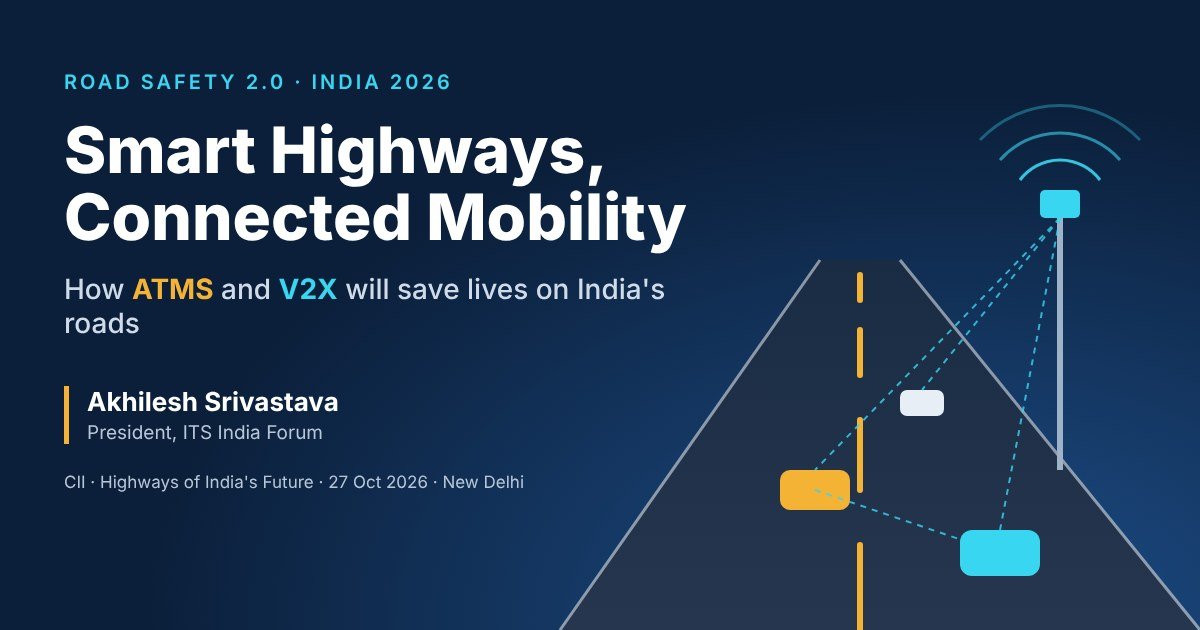
This is not science fiction. India is building it now. On 27 October 2026, I will moderate Session V: Smart Highways, Connected Mobility: The ATMS–V2V Revolution at the Confederation of Indian Industry’s Highways of India’s Future: Smart, Safe and Sustainable at Hotel Taj Mansingh, New Delhi. Here is why this conversation matters, and where India is heading.
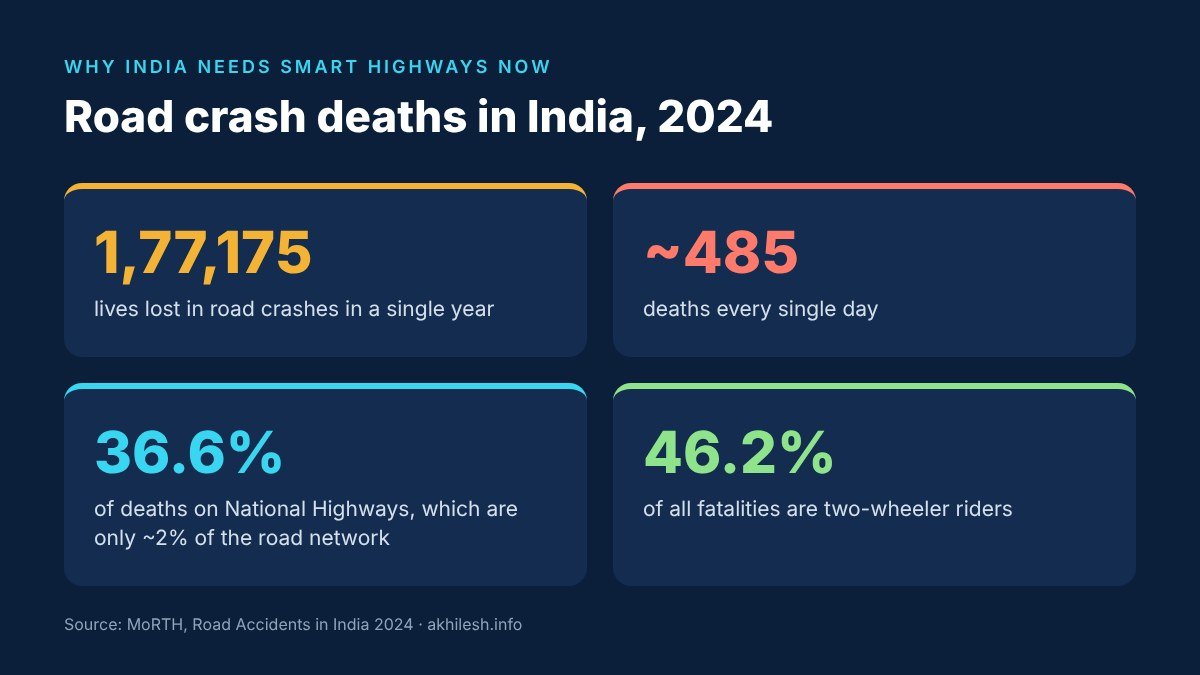
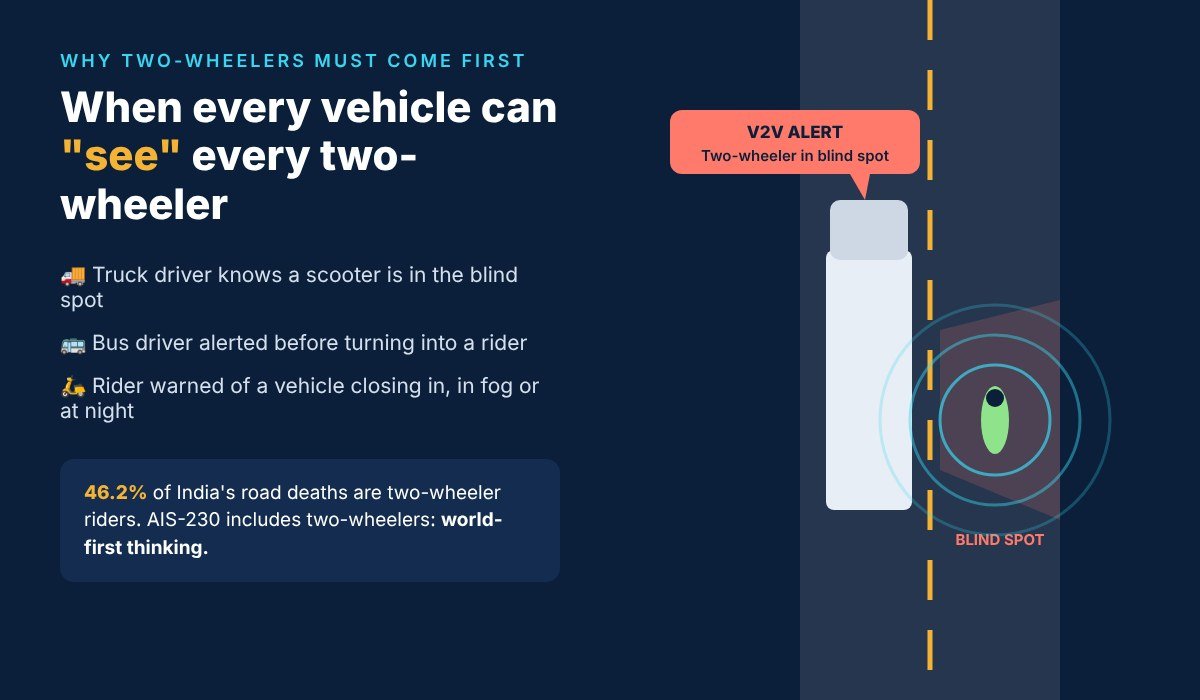
India lost 1,77,175 lives in road crashes in 2024, about 485 every single day, according to the Ministry of Road Transport and Highways’ Road Accidents in India 2024 report. National Highways form only about 2% of the road network, yet account for 36.6% of these deaths. Two-wheeler riders alone make up 46.2% of all fatalities.
Behind every number is a family that waits at the door in vain. Smart highways are not a luxury for India; they are a life-saving necessity. This is the heart of what I call Road Safety 2.0: preventing crashes by design, not merely reacting to them.
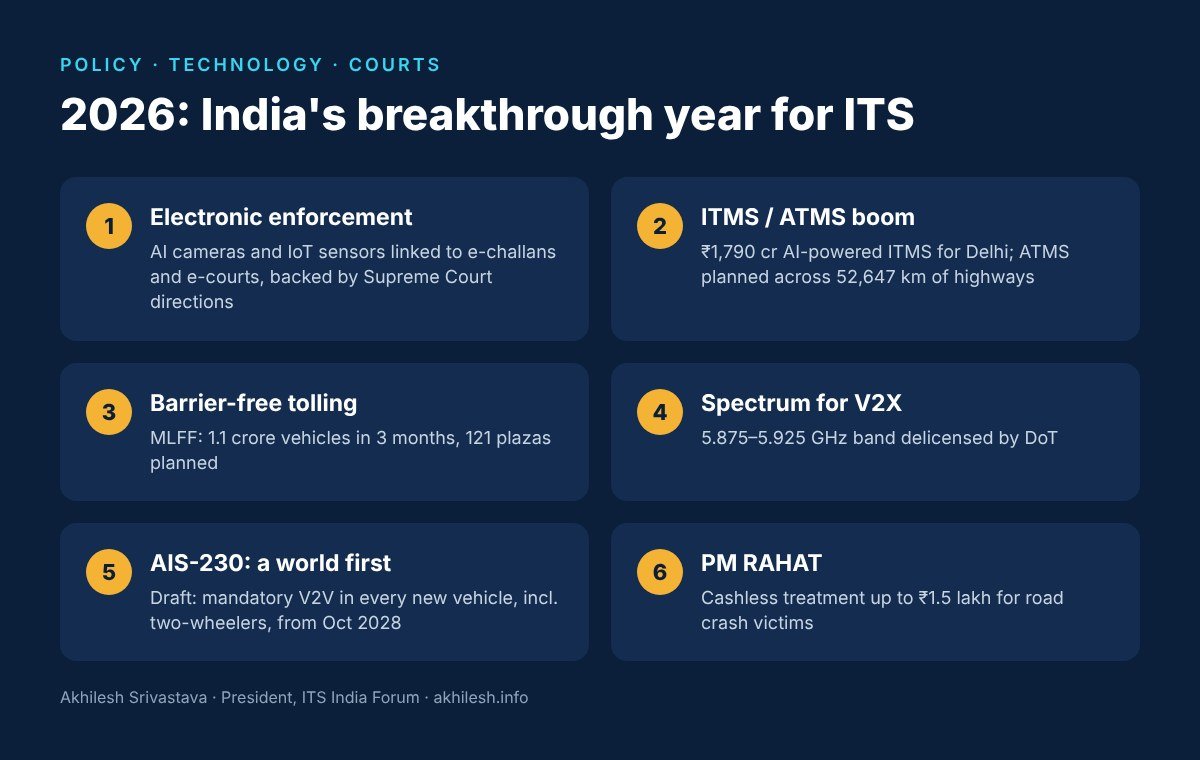
In more than three decades in highways and technology, I have not seen a year like this one. Policy, technology and the courts are finally moving together:
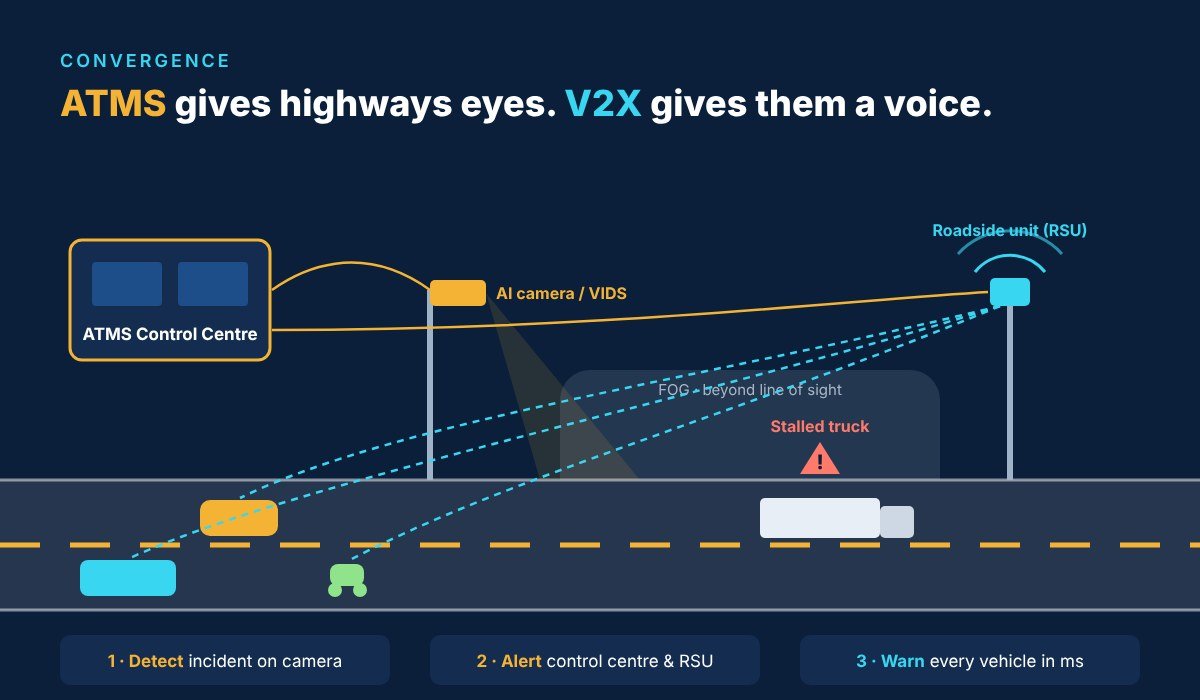
Advanced Traffic Management Systems (ATMS) are the eyes and control room of a highway. AI-based video incident detection, number-plate recognition, speed displays, variable message signs and command centres detect incidents, warn road users and dispatch help within the golden hour.
But ATMS sees the road from the outside and speaks to drivers mainly through roadside signs. V2X (Vehicle-to-Everything) communication closes that gap. Vehicles, roadside units, control centres and vulnerable road users exchange warnings in milliseconds, even beyond line of sight: in fog, at night, around a blind curve.
The real value lies in convergence. An ATMS that detects a stalled truck, fog or a wrong-way vehicle should broadcast that warning straight into every approaching vehicle, while anonymised vehicle data flows back to the control centre. The future is when the road talks to every vehicle on it. I explain the technology in depth in my V2X and C-V2X guide for India.
Nearly half of India’s road deaths are two-wheeler riders. Most die not because they were not seen, but because they were not seen in time. With V2V:
When every vehicle can “see” every two-wheeler, the biggest killer on Indian roads loses its power. That is why India’s decision to include two-wheelers in AIS-230 is world-first thinking.
I am honoured to share the stage with Shri Vishal Chauhan (Chairman, IHMCL, and Member, NHAI), Shri RS Singh (DDG, Department of Telecommunications), Anoop G. Prabhu (Vehant Technologies), Suman Sehra (HARMAN Automotive), Rajat Mishra (EFKON STRABAG) and Arindam Das (Qualcomm), on a day featuring Hon’ble Minister for Road Transport and Highways, Shri Nitin Gadkari Ji.
📍 Hotel Taj Mansingh, New Delhi | 🗓️ 27 October 2026 | ⏰ 3:05 PM
See all my upcoming events and past keynotes, including the ITS World Congress 2026 in Gangneung, South Korea.
Smarter highways. Safer journeys. Every life returns home.
V2X (Vehicle-to-Everything) lets vehicles, roadside infrastructure and road users exchange safety warnings in milliseconds, without depending on mobile network coverage. It can warn drivers of hidden hazards such as stalled vehicles, wrong-way drivers, sudden braking and two-wheelers in blind spots.
AIS-230 is India’s proposed Automotive Industry Standard for vehicle-to-vehicle (V2V) communication. Under MoRTH’s draft notification of August 2026, V2V would become mandatory in all new two-wheelers, three-wheelers, cars, buses and trucks from 1 October 2028.
ATMS (Advanced Traffic Management System) is typically deployed on highways and expressways for incident detection, enforcement and traveller information. ITMS (Intelligent Traffic Management System) is the urban equivalent, managing traffic signals, junctions and enforcement in cities.
Akhilesh Srivastava is the President of the ITS India Forum and a global technology leader in intelligent transport and road safety. He is the former COO of IHMCL (FASTag), former CEO of NHAI InvIT and former Chief General Manager at NHAI, and leads the World Economic Forum’s Road Safety 2.0 initiative in India. He is the author of A Dream of Billions: Road Safety 2.0, Artificial Intelligence in Infrastructure Development, Digital Construction Management and Construction Industry 2.0.
Akhilesh Srivastava is President of the ITS India Forum, Chairman of the Bitumen India Forum, Chair of the CII Road Safety Committee and Road Safety Ambassador of the International Road Federation. An IIT gold medallist and former COO of FASTag, he advises governments and global organisations on intelligent transport, digital infrastructure and road safety.
📚 Books & publications | 📰 Media coverage | 🎤 Speaking | 🤝 Book an advisory session
Follow: LinkedIn | X (@Akhilesh_gtl)
WhatsApp us