SMART MOBILITY AND ITS DEVELOPMENT IN DELHI

Executive Summary

Delhi, as the national capital and urban heart of India, leads the country in Intelligent Transportation Systems (ITS) deployment, integration, and innovation. The city has implemented a wide range of advanced mobility technologies—from citywide traffic automation and e-challan systems to multimodal public transit integration and expressway ITS.

The city’s ITS vision is driven by institutions such as the Delhi Transport Department, Delhi Traffic Police, Delhi Metro Rail Corporation (DMRC), and New Delhi Municipal Council (NDMC). With a growing focus on AI-based traffic enforcement, real-time public transit monitoring, and seamless multimodal integration through the National Common Mobility Card (NCMC), Delhi has positioned itself as a benchmark for smart urban mobility in India.

Flagship initiatives include the deployment of over 1,000 smart traffic junctions, introduction of AI-powered Integrated Traffic Management Systems (ITMS), real-time bus tracking and alert systems under AIS-140, smart parking pilots, and ITS applications across expressways and the Delhi-Meerut RRTS corridor.

With continued investments, strong inter-agency coordination, and a data-driven approach to mobility, Delhi represents a mature ITS ecosystem that is now evolving toward predictive, integrated, and citizen-centric transport solutions.

Urban Mobility & Transportation Challenges

Delhi, despite its extensive transport infrastructure and policy innovation, faces chronic urban mobility issues exacerbated by rapid population growth, vehicular density, and inter-regional traffic pressure from the National Capital Region (NCR).

Key Urban Mobility Challenges:

  • Severe Traffic Congestion:
    With over 1.2 crore registered vehicles and high modal dependence on private transport, Delhi consistently ranks among the most congested cities globally.
  • Air Pollution from Traffic:
    Vehicle emissions are a major contributor to Delhi’s PM2.5 levels, especially during winters, prompting the need for eco-driving enforcement, traffic rationalization, and EV transition supported by ITS.
  • Manual Enforcement Overload:
    Despite strong deployment, traffic violation management still requires backup manual support, particularly at secondary intersections and in high-risk zones.
  • Multimodal Integration Gaps:
    Delhi Metro, DTC buses, cluster buses, e-rickshaws, and suburban rail systems are not yet fully synchronized in terms of schedules, apps, and payment modes—affecting commuter convenience.
  • Event-Driven Traffic Disruptions:
    Frequent political gatherings, festivals, and VIP movements create unpredictable congestion, requiring real-time incident detection and dynamic re-routing tools.
  • Parking and Last-Mile Inefficiencies:
    Poorly managed parking and uncoordinated last-mile transport add to road clutter, idle emissions, and travel delays in commercial and residential areas.

Current Mitigation Measures:

  • Deployment of AI-based ITMS at 500+ intersections to reduce red-light violations and improve traffic signal responsiveness.
  • Expansion of AVL and Emergency Alert Systems (EAS) under AIS-140 standards for bus safety and tracking.
  • Integration of NCMC-enabled ticketing across metro and bus services for seamless multimodal access.
  • Introduction of smart parking systems with mobile visibility and dynamic pricing in areas under NDMC.

ITS Deployment & Technological Adoption

Delhi has emerged as one of the most advanced cities in India in terms of ITS deployment and technological integration. The city’s strategy is built on the pillars of AI-driven traffic enforcement, multimodal transport coordination, and smart city digital infrastructure. ITS is being actively deployed across enforcement, public transport, expressways, and urban traffic management.

Major Areas of ITS Deployment in Delhi:

  • AI-Based Integrated Traffic Management Systems (ITMS):
    As of 2024, Delhi is deploying AI-enabled ITMS at over 500 intersections, using ANPR, RLVD, and speed violation detection systems. These are integrated with Delhi Police’s control room and linked to the Vahan database for real-time e-challan issuance.
  • Vehicle Location Tracking and Emergency Alert Systems (VLT & EAS):
    All public buses are now fitted with AIS-140 compliant VLT devices and EAS buttons, monitored centrally to improve passenger safety and fleet traceability.
  • Delhi Metro ITS Integration:
    Delhi Metro Rail Corporation (DMRC) uses Communication-Based Train Control (CBTC), passenger information display systems (PIDS), and automated fare collection systems with NCMC compatibility for high-speed, high-efficiency urban transit.
  • Real-Time Public Bus Tracking:
    DTC and cluster buses are equipped with AVL systems, allowing commuters to view real-time arrival information via mobile applications and at major terminals.
  • Smart Parking Systems (NDMC):
    NDMC has launched smart parking in high-traffic zones like Connaught Place, equipped with IoT sensors, digital signage, and mobile app integration for booking and payments.
  • ITS on Expressways & RRTS Corridor:
    The Eastern Peripheral Expressway (EPE) and Delhi-Meerut RRTS incorporate ITS tools like ATMS, toll management systems, and passenger information systems for seamless express and intercity travel.

Key Technologies Used:

  • AI and deep learning-based traffic violation detection
  • Adaptive signal control and traffic load sensing
  • IoT-enabled smart parking and lighting infrastructure
  • NCMC-based automated fare collection
  • Real-time AVL, EAS, and cloud-connected control centers

Delhi’s ITS ecosystem represents a multi-agency, platform-centric model that enables data sharing, predictive analytics, and responsive mobility services at scale.

Key ITS Projects in Delhi

Delhi has initiated several large-scale ITS projects that target enforcement automation, multimodal integration, and real-time transport visibility. These projects are implemented by Delhi Police, Transport Department, DMRC, and smart city bodies.
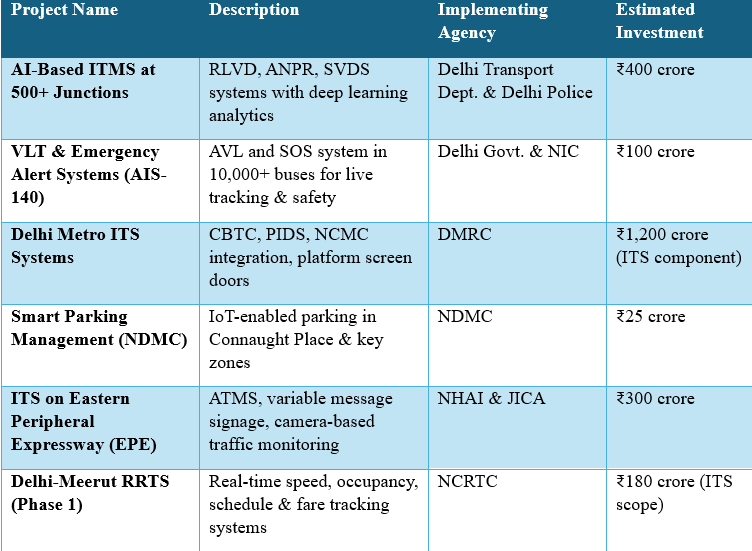
Highlighted ITS Projects:

Key ITS Projects in Delhi

These projects reflect Delhi’s transition toward automation, predictive enforcement, and multimodal synergy, positioning it as one of India’s top ITS-ready cities.

Scroll to Top